
Have you ever wondered whether ice will stay frozen if you leave it inside a countertop ice maker?
Most standard countertop ice makers don't keep ice frozen indefinitely. They freeze water to make ice, then hold the finished ice in a storage basket that is usually insulated rather than refrigerated like a freezer. As a result, ice can gradually melt while it sits in the basket.
The good news is that a countertop ice maker can still be a convenient way to enjoy fresh ice at home. The key is understanding how it makes ice, how its storage system works, and what to do when you want to save ice for later.
In this guide, we'll explain why ice melts inside countertop ice makers, how to keep it frozen for longer, and what to look for before choosing a machine for your kitchen or home bar.
Do Countertop Ice Makers Actually Keep Ice Frozen?
In most cases, no. A standard countertop ice maker is designed primarily to produce ice, not to store it in a permanently frozen state.
Here's how the process generally works:
- Water freezes: The machine uses a refrigeration system to turn water into ice.
- Ice is collected: Finished ice moves into a separate basket or storage bin.
- Ice is stored temporarily: The basket holds the ice until you scoop it out or the machine detects that it is full.
The important detail is the difference between making ice and keeping it frozen.
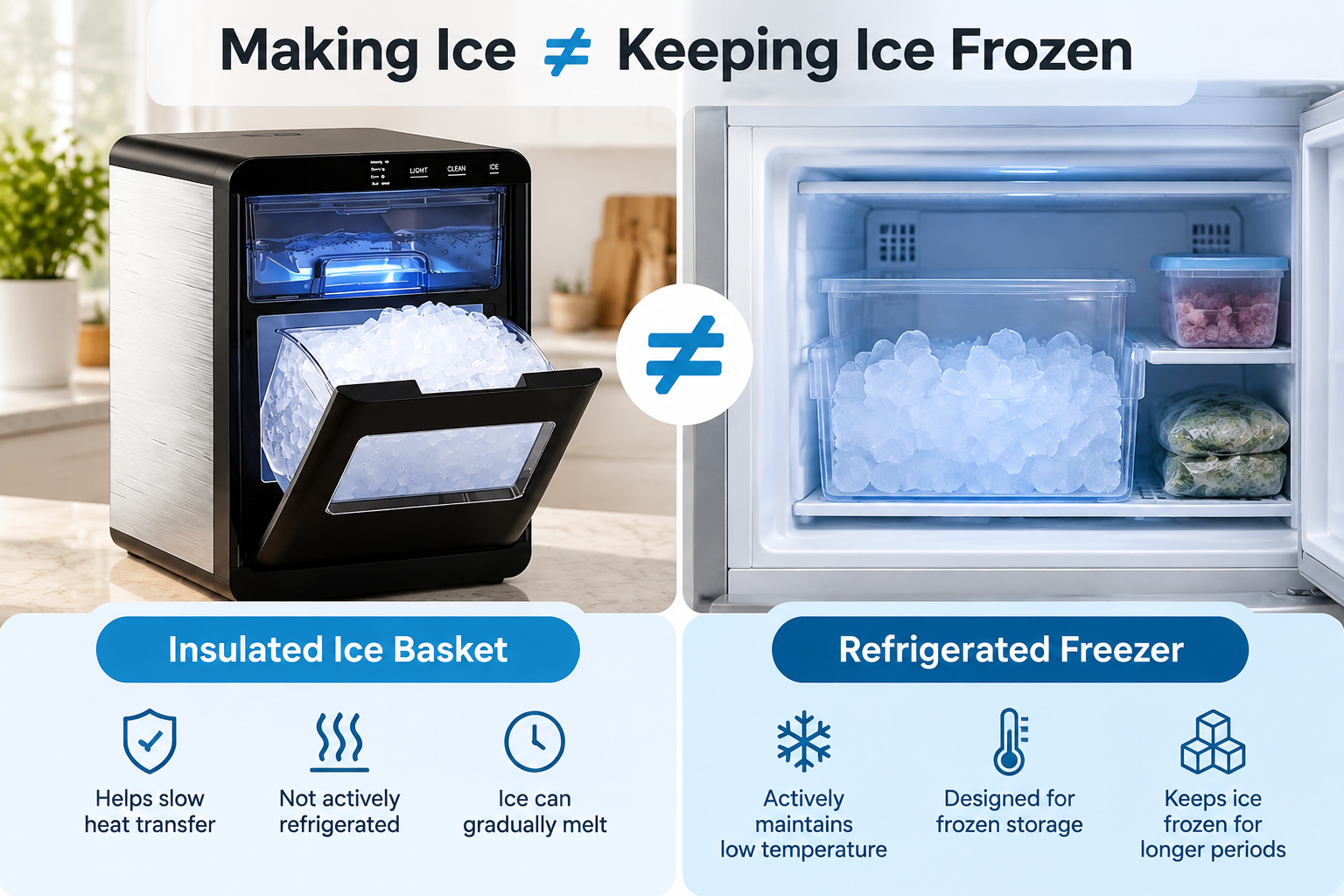
A freezer actively maintains a low temperature to preserve frozen food and ice. An insulated ice basket, on the other hand, slows the transfer of heat from the surrounding environment but does not necessarily have its own cooling system.
That means the ice can begin to melt even when the machine is operating normally.
Insulated Ice Baskets vs. Refrigerated Freezers
An insulated basket can help slow melting, which gives you time to use freshly produced ice. However, insulation alone cannot maintain a freezing temperature indefinitely.
A freezer is designed for longer-term frozen storage. A standard countertop ice maker is generally better suited to making fresh ice when you need it.
Some specialized appliances may offer refrigerated ice storage, but you should never assume a machine has this feature simply because it makes ice or advertises an insulated basket.
Before buying, check whether the product specifications explicitly describe refrigerated or freezer-style storage.
Why Does Ice Melt Inside a Countertop Ice Maker?
If ice melts inside your machine, it doesn't automatically mean something is wrong. Several factors can affect how quickly it melts.
1. The Ice Basket Usually Isn't Refrigerated
Many countertop ice makers collect finished ice in a non-refrigerated basket.
Once the ice leaves the active ice-making area, it is exposed to the temperature inside the storage compartment. Heat gradually transfers into the ice, causing it to melt.
An insulated basket may slow this process, but it generally cannot stop it completely.
2. Room Temperature Makes a Difference
The environment around your ice maker matters.
A machine placed in a warm kitchen, near direct sunlight, beside an oven, or close to another heat-producing appliance may experience conditions that encourage faster melting.
For better results, place your ice maker in a suitable location with the ventilation clearance specified by the manufacturer. Avoid placing it near heat sources or blocking its air vents.
3. Opening the Basket Introduces Warm Air
Every time you open the basket or remove ice, the storage compartment is exposed to the surrounding air.
Frequent access can contribute to melting, particularly in a warm room.
If you are preparing drinks for a gathering, consider making ice in batches and transferring any extra ice to your freezer rather than leaving a large quantity in the machine for an extended period.
4. Ice Shape and Storage Conditions Matter
Different types of ice have different shapes, sizes, and surface areas. These characteristics can affect how quickly ice exchanges heat with its surroundings.
For example, nugget ice consists of small, chewable pieces, while larger cubes have a different shape and surface area.
However, ice type alone doesn't determine how long ice will last. The storage environment, basket design, and temperature also matter.
There is no single melting time that applies to every countertop ice maker.
What Happens When the Ice Basket Is Full?
Many countertop ice makers include an ice-full sensor or indicator.
When the basket reaches the detected full level, the machine may pause ice production. Depending on the model, production may resume after enough ice is removed or the detected ice level drops.
This feature helps manage ice production, but it does not necessarily mean the machine is freezing the stored ice.
It's also important to understand that different machines handle melted ice water differently. Some designs may allow water to return to the reservoir, while others may have different drainage or water-management arrangements.
Check your owner's manual to understand how your particular machine works.
If your model allows water to recirculate, follow its instructions for keeping the reservoir clean and maintaining water quality. Do not assume that every ice maker automatically recycles melted ice.
An ice-full indicator is not the same as a freezer function. It tells you about the machine's ice-production or storage status, not necessarily the temperature of the ice basket.
How Long Does Ice Last in a Countertop Ice Maker?
There is no universal answer.
Ice may remain usable for different lengths of time depending on the machine's design and the conditions in which it operates.
The main factors include:
- Room temperature: Warmer surroundings generally encourage faster melting.
- Basket insulation: Better insulation can slow heat transfer, but it doesn't guarantee that ice will remain frozen.
- Ice type: Different shapes and sizes exchange heat differently.
- How often the basket is opened: Frequent access can expose the ice to warmer air.
- Storage conditions: The amount of ice, the surrounding environment, and the machine's design all play a role.
For these reasons, it would be misleading to promise that ice in every countertop ice maker will last a particular number of hours.
If you need ice for drinks throughout the day, making it as needed may be the simplest approach.
If you need to prepare ice well in advance for a party, transferring it to a freezer is generally a more reliable solution.
How to Keep Ice From Melting Too Quickly
Although you generally cannot prevent melting indefinitely in a standard countertop ice maker, a few practical habits can help you manage your ice more effectively.
1. Transfer Extra Ice to Your Freezer
This is the most useful step if you want to save ice for later.
Use a clean scoop to transfer freshly made ice into a suitable freezer-safe container or bag, then place it in your freezer.
Keeping extra ice in a freezer helps maintain its frozen state instead of relying on the insulation of the machine's basket.
One thing to keep in mind: nugget ice may stick together after freezing. This can change its texture and make individual pieces harder to separate.
If you prefer loose, easy-to-scoop ice, storing smaller batches may help.
2. Keep Your Ice Maker Away From Heat Sources
Choose a location that meets the manufacturer's installation requirements.
Avoid placing the machine directly beside an oven, in direct sunlight, or in an area with excessive heat.
Also, make sure that the ventilation openings remain clear. Proper ventilation is important for the appliance to operate as intended.
3. Make Ice Closer to When You Need It
A countertop ice maker is often most convenient when used to produce fresh ice throughout the day.
For everyday drinks, you can make a batch before breakfast, prepare more when needed, or start producing ice before guests arrive.
For larger gatherings, estimate how much ice you'll need in advance and store any extra ice in a freezer.
This approach can be more practical than expecting a countertop ice maker to act as a long-term ice storage unit.
4. Keep the Machine Clean
Regular cleaning helps maintain the machine's water system and ice-making components.
Follow the cleaning schedule and procedures in your product manual. Use only approved cleaning products and methods, and rinse the machine as instructed.
Cleaning does not turn an insulated basket into a freezer, but it is an important part of maintaining an ice maker for everyday use.
5. Choose the Right Machine for Your Needs
If you primarily want fresh ice for water, iced coffee, soda, or cocktails, a countertop ice maker may be a good fit.
If you frequently prepare large quantities of ice in advance, consider how you will store it.
Look at both daily ice production and storage capacity rather than choosing a machine based on its production rating alone.
Countertop Ice Maker vs. Freezer vs. Undercounter Ice Maker
Not every appliance serves the same purpose. Understanding the differences can help you choose the right setup for your home.
| Feature | Countertop Ice Maker | Freezer | Typical Undercounter Ice Maker |
|---|---|---|---|
| Primary purpose | Making fresh ice | Keeping items frozen | Producing larger quantities of ice |
| Makes ice automatically | Usually, depending on the model | Only if equipped with an ice maker | Usually |
| Keeps stored ice frozen long-term | Usually no | Yes | Usually no, unless refrigerated storage is specifically provided |
| Storage design | Often an insulated basket | Refrigerated compartment | Often an insulated bin |
| Best suited for | Everyday drinks and smaller spaces | Saving ice for later | Frequent entertaining or higher ice demand |
These are general distinctions, not guarantees for every appliance. Always check the individual model's specifications.
When Should You Choose a Countertop Ice Maker?
A countertop machine may suit you if you want fresh ice without installing a larger appliance.
It can be a practical option for everyday beverages, small households, offices, and home bars where counter space is available.
When Should You Rely on a Freezer?
A freezer is the better choice when you need to preserve ice for later use.
For example, if you're preparing drinks for a holiday gathering the following evening, you can make ice in advance and transfer it to your freezer.
When Should You Consider an Undercounter Ice Maker?
An undercounter ice maker may be worth considering if your household or business uses ice frequently and needs greater daily production capacity.
However, a larger machine doesn't automatically provide frozen storage. Many undercounter models also use insulated storage bins.
Before buying, check the machine's daily production rating, bin capacity, plumbing requirements, and whether it offers any form of refrigerated storage.
If you're comparing options for a home bar, our home bar ice maker sizing guide can help you think through your daily ice needs.
What Should You Look for Before Buying a Countertop Ice Maker?
Once you understand how ice storage works, choosing the right machine becomes easier.
Here are five things worth checking.
1. Daily Ice Production vs. Storage Capacity
These two specifications describe different things.
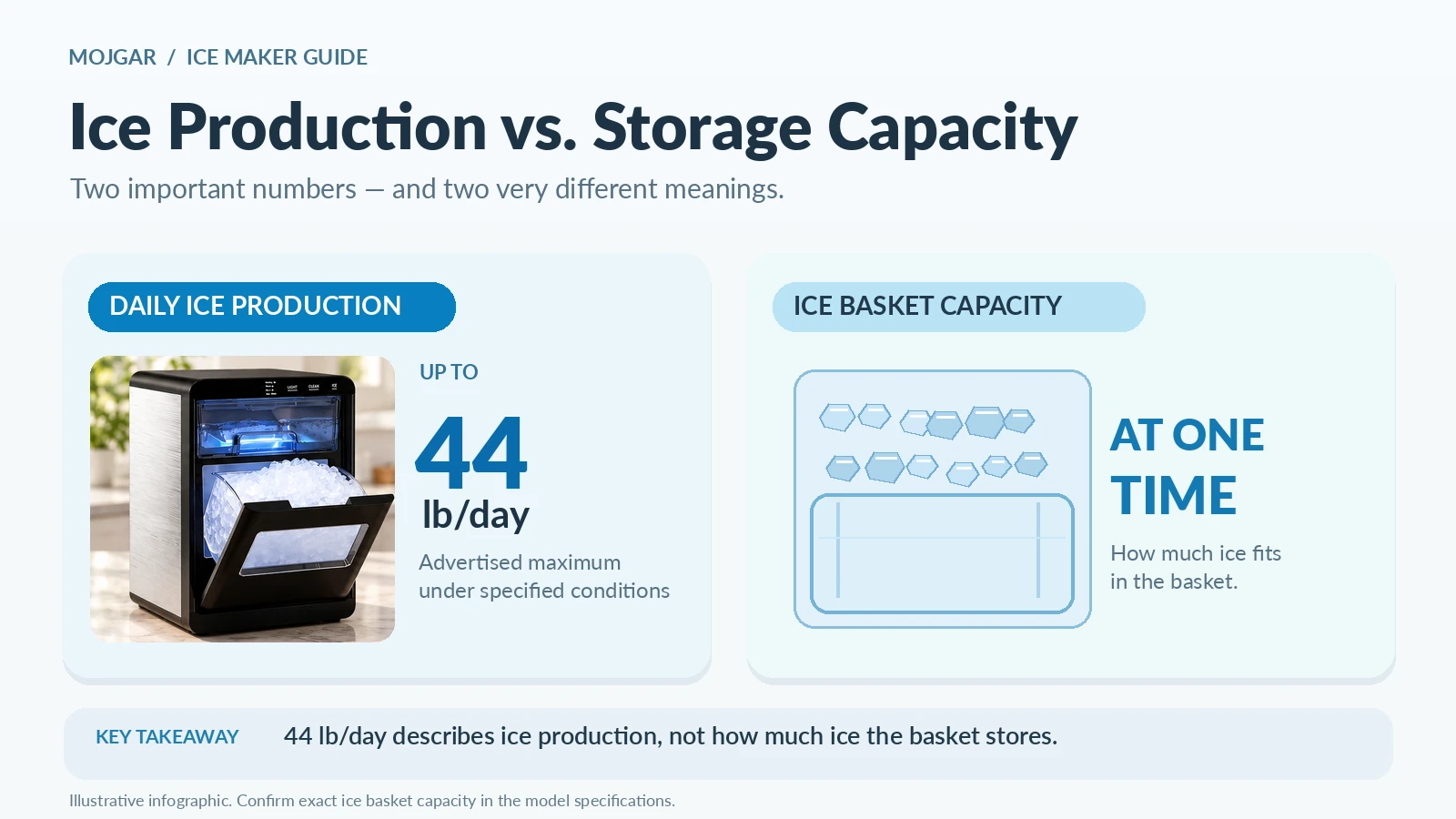
Daily production indicates how much ice a machine is advertised to produce over a specified period. Storage capacity indicates how much ice its basket can hold at one time.
For example, Mojgar's 44 lb/day Nugget Ice Maker is listed with up to 44 pounds of daily ice production and a 2.65-liter ice basket.
The daily production figure does not mean that the basket can hold 44 pounds of ice simultaneously.
When comparing models, look at both specifications and consider how often you plan to use ice.
2. The Type of Ice You Prefer
Different ice makers produce different ice shapes and textures.
Nugget ice is soft and chewable, making it popular for everyday drinks, while other machines may produce bullet-shaped or cube-shaped ice.
Think about how you typically use ice before deciding which type is right for you.
3. Cleaning and Maintenance
An ice maker needs regular care, even if it includes a self-cleaning feature.
Check whether the model has removable components, what the cleaning process involves, and which maintenance tasks must be performed manually.
A self-cleaning function should not be assumed to replace every cleaning or sanitizing step.
4. Counter Space and Ventilation
Measure your available space before purchasing.
Check the appliance's dimensions, lid or drawer clearance, power requirements, and ventilation instructions.
A compact machine may be convenient, but it still needs enough room to operate according to the manufacturer's directions.
5. Warranty and Customer Support
Before placing an order, review the warranty terms, return policy, and available support channels.
These details matter because an appliance should be evaluated not only by its advertised features, but also by the support available if you need help after purchase.
Is a Mojgar Countertop Ice Maker Right for You?
If you enjoy fresh nugget ice for everyday drinks, a countertop ice maker may be worth considering.
Mojgar offers a 44 lb/day Countertop Nugget Ice Maker designed for home kitchens, offices, and home bars.
The product listing includes a removable ice basket and a self-cleaning function. It also describes an insulated design.
It's important to understand what that means: an insulated design should not be interpreted as a guarantee that ice will remain frozen indefinitely. If you want to keep extra ice for later, plan to transfer it to a freezer.
Before choosing this model, review its current specifications, dimensions, basket capacity, and cleaning instructions to make sure it fits your routine.
A countertop nugget ice maker may be a practical option if your priority is convenient access to freshly made ice. If your main requirement is long-term frozen storage, you should plan for a separate freezer or look specifically for an appliance with verified refrigerated storage.
Explore the Mojgar 44 lb/day Nugget Ice Maker
Frequently Asked Questions
Does a countertop ice maker keep ice frozen overnight?
Most standard countertop ice makers do not keep ice frozen overnight in the same way a freezer does. The ice may gradually melt inside the insulated basket. If you want to save ice overnight, transfer it to your freezer.
Does a countertop ice maker have a freezer inside?
Usually not. Most standard countertop ice makers have an ice-making system and a separate storage basket, rather than a refrigerated freezer compartment. Check the product specifications if frozen storage is important to you.
Why does ice melt inside my ice maker?
Ice can melt because the storage basket is not actively refrigerated. Room temperature, insulation, ventilation, and how often the basket is opened can also affect melting.
Some melting during normal use does not necessarily indicate a malfunction.
Can I leave my countertop ice maker on all day?
Follow your specific model's operating instructions. Some machines are designed to produce ice as needed and may pause when the basket is full, but operating conditions and maintenance requirements vary by model.
Do not assume that every ice maker supports unattended or continuous operation.
Can I put countertop ice maker ice in the freezer?
Yes. In general, you can transfer freshly made ice to a suitable freezer-safe container and store it in your freezer.
Use a clean scoop and follow appropriate food-handling practices. Nugget ice may stick together after freezing, so the texture may be different when you take it out.
Does an insulated ice basket keep ice frozen longer?
Insulation can slow heat transfer and may help ice melt more slowly than it would in a less-insulated container. However, insulation alone does not provide active refrigeration or guarantee that ice will remain frozen.
Is a countertop ice maker better than a refrigerator ice maker?
It depends on your needs. A countertop machine may provide a convenient way to make a particular style of ice or produce ice independently of your refrigerator. A refrigerator with a built-in ice maker may be more convenient for households that already have suitable freezer space.
Compare ice type, production capacity, storage, available space, and maintenance before deciding.
Are there ice makers that keep ice frozen?
Some specialized appliances may offer refrigerated ice storage, but this is not a standard feature of every ice maker.
Look for explicit manufacturer specifications confirming refrigerated storage. Do not assume that a larger storage bin, an insulated basket, or a higher daily production rating means the appliance can keep ice frozen.
Final Thoughts: Making Ice and Keeping Ice Frozen Are Different
A countertop ice maker can make it easier to enjoy fresh ice at home, but most standard models are not designed to replace a freezer.
Before buying, consider how much ice you need each day, how much the basket can hold, and whether you'll need to store extra ice for later.
If you mainly want fresh ice for everyday drinks, a countertop machine may be a convenient choice. If you need to keep ice frozen for hours or overnight, transferring it to a freezer is generally the more reliable option.
Understanding this difference can help you choose an ice maker that matches your actual needs—and avoid disappointment after purchase.
Ready to make fresh nugget ice at home?
Explore the Mojgar Countertop Nugget Ice Maker and review its features and specifications to see whether it's the right fit for your kitchen or home bar.