
If you're planning to add an undercounter ice maker to your kitchen, home bar, office, or entertainment space, one of the most important questions to answer before buying is surprisingly simple:
Does an undercounter ice maker need a drain?
The answer is: not always.
Some undercounter ice makers rely on a gravity drain, some use a drain pump, and others are specifically designed as drainless ice makers that do not require a dedicated external drain line.
Understanding the difference before you buy can save you from unexpected plumbing work and help you choose an ice maker that actually fits your space.
In this guide, we'll explain how each drainage option works, where it makes the most sense, and what to check before installing your next undercounter ice maker.
Why Do Some Undercounter Ice Makers Need a Drain?
Ice makers work with water continuously, so depending on the design of the machine, there may be water that needs to leave the unit during normal operation.
This can include water generated during:
- Ice-making cycles
- Ice melting inside the storage bin
- Cleaning cycles
- Routine water circulation and discharge
One important detail many first-time buyers don't realize is that the storage bin in many undercounter and commercial ice makers is insulated rather than refrigerated like a freezer.
That means some stored ice may gradually melt over time. On models that require drainage, that meltwater needs somewhere to go.
This is why the drainage setup matters just as much as the water supply when planning an undercounter ice maker installation.
Fortunately, not every installation requires the same solution.
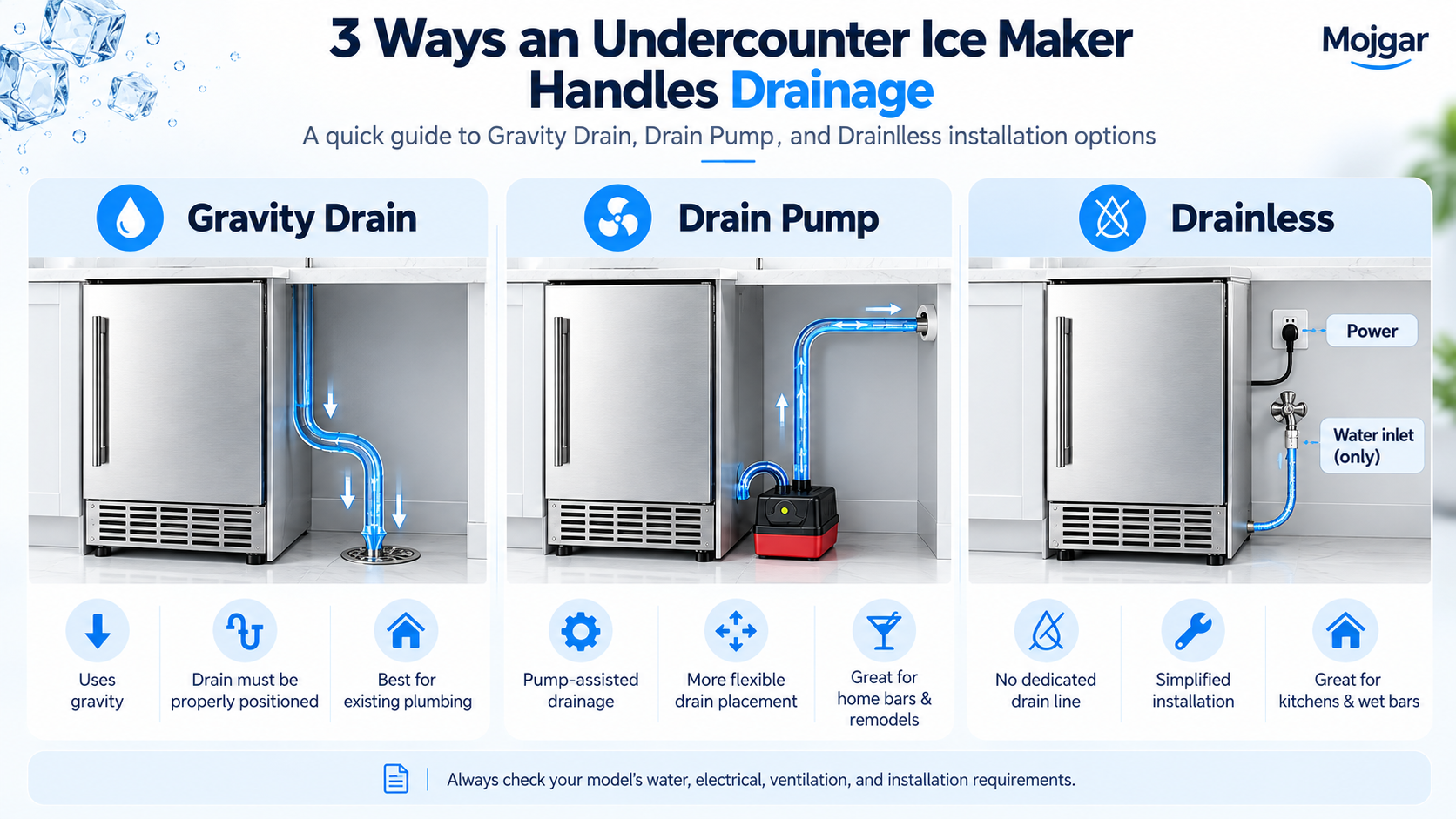
The 3 Main Types of Ice Maker Drainage
Most undercounter ice maker installations fall into one of three categories:
| Drain Type | Dedicated Drain Needed? | Best For | Key Benefit |
|---|---|---|---|
| Gravity Drain | Yes | Locations with a properly positioned drain nearby | Simple, passive drainage |
| Drain Pump | Yes | Locations where gravity drainage is impractical | Greater installation flexibility |
| Drainless | No dedicated external drain line | Kitchens, wet bars, offices and spaces without convenient drainage | Simplified installation |
The right option depends less on which one is "best" and more on the plumbing conditions in the location where you plan to install your ice maker.
Let's look at each type more closely.
Option 1: Gravity Drain Ice Maker
How Does a Gravity Drain Work?
A gravity drain uses exactly what its name suggests: gravity.
Wastewater flows from the ice maker through a drain hose and downward toward an approved drain location.
Because there is no pump actively moving the water, the drain line must be installed in a way that allows water to flow downward naturally.
This can make a gravity-drain ice maker a straightforward solution when the installation location already has appropriate plumbing nearby.
When Does a Gravity Drain Make Sense?
A gravity drain may be a good choice when:
- A floor drain is nearby
- A suitable drain connection is positioned lower than the ice maker's drain outlet
- The drain hose can maintain the required downward routing
- The space is already prepared for an ice maker or similar appliance
This type of setup is commonly found in commercial kitchens, restaurant preparation areas, bars, cafés, and other spaces with existing plumbing.
Advantages of a Gravity Drain
A gravity system has several benefits:
- Simple drainage design
- No separate drain pump required
- Fewer mechanical components involved in drainage
- Well suited for locations already designed around commercial appliances
What Should You Check?
Before buying a gravity-drain model, look closely at the installation location.
Ask yourself:
Where is the nearest drain?
Is it positioned appropriately for gravity drainage?
Can the hose run downward without being kinked or routed upward?
Does the installation comply with the machine's instructions and local plumbing requirements?
If the answer to one or more of those questions is no, a drain-pump or drainless model may make installation easier.
Option 2: Ice Maker With a Drain Pump
What Does a Drain Pump Do?
A drain pump actively moves wastewater away from the ice maker rather than relying entirely on gravity.
This provides more flexibility when the available drain is not ideally positioned for a gravity system.
For example, imagine installing an undercounter nugget ice maker in a home bar. You have access to water and electricity, but the most practical drain connection is farther away from the machine.
A pump-assisted system may provide a better solution than trying to create a suitable gravity drain path.
When Should You Consider a Drain Pump?
A drain pump can be especially useful in locations such as:
- Home bars
- Kitchen islands
- Basement entertainment areas
- Offices
- Cafés
- Beverage stations
- Renovated spaces where plumbing options are limited
It may also make sense when a drain exists but its position makes gravity drainage impractical.
Advantages of a Drain Pump
The biggest advantage is installation flexibility.
A pump can help make an undercounter ice maker possible in spaces where the location of the drain would otherwise limit your options.
Other potential benefits include:
- More freedom when choosing appliance placement
- Less dependence on the drain being directly below or beside the machine
- Useful for remodeled spaces where changing plumbing would be difficult
Things to Consider
A drain pump is still part of the machine's drainage system, so installation requirements matter.
Always check:
- The pump specifications for your model
- Maximum permitted drain routing
- Hose placement
- Electrical requirements
- Local plumbing requirements
A pump also adds another mechanical component to the system, so proper installation and maintenance are important for reliable performance.
Mojgar Option: Undercounter Nugget Ice Maker With Drain Pump
For spaces where gravity drainage is inconvenient, the Mojgar 80 Lbs/24H Undercounter Nugget Ice Maker includes an external drain pump.
It combines high-capacity nugget ice production with a more flexible drainage setup, making it suitable for home bars, kitchens, offices, cafés, and other beverage-focused spaces.
Option 3: Drainless Ice Maker
What Does "Drainless" Mean?
A drainless ice maker is designed to operate without a dedicated external drain-line connection.
That distinction is important.
"Drainless" does not necessarily mean the appliance needs no plumbing or water connection at all.
Depending on the model, you may still need:
- A water supply
- A properly grounded electrical outlet
- Adequate ventilation and installation clearance
The difference is that you don't need to add a separate drain line for the appliance.
Always check the requirements for the specific model before installation.
Why Choose a Drainless Ice Maker?
For many homeowners, the biggest advantage is simplicity.
Adding a drain line to an existing kitchen or wet bar can require additional plumbing work. If the room is already finished, that can make what seemed like a simple appliance upgrade much more complicated.
A drainless design can be especially attractive for:
Home Kitchens
You want built-in ice without significantly changing existing cabinetry or drainage.
Wet Bars
The bar already has a water source and electrical outlet, but no dedicated appliance drain.
Apartments or Condos
Major plumbing modifications may not be practical or permitted.
Offices
A simple installation may be preferable to modifying the building's drainage system.
Game Rooms and Entertainment Areas
You want convenient ice close to guests without designing the entire room around a floor drain.
Mojgar Option: Drainless Crescent Ice Maker
The Mojgar 25 Lbs/24H Drainless Under Counter Ice Maker is designed for installations where a dedicated drain line isn't available or desired.
It offers up to 25 lbs of crescent ice per day, 22 lbs of ice storage, built-in or freestanding installation, adjustable height, and a reversible door.
For a home kitchen or wet bar where installation convenience matters as much as ice production, a drainless model can be an appealing alternative to traditional drain-dependent machines.
Gravity Drain vs. Drain Pump vs. Drainless: Which Should You Choose?
There isn't one drainage system that's right for everyone.
A simple way to choose is to start with your installation location.
Choose a Gravity Drain If:
You already have an appropriately positioned drain and can provide the drainage configuration required by the ice maker.
This is often the most straightforward solution for commercial or purpose-built spaces.
Choose a Drain Pump If:
You have access to a suitable drain, but its location makes gravity drainage difficult.
A pump can provide more flexibility when placing the ice maker.
Consider a Drainless Ice Maker If:
There is no convenient drain near your preferred installation location and you want to avoid installing a dedicated drain line.
This can be especially useful in residential kitchens, home bars, offices, and finished entertainment areas.
Quick Ice Maker Drain Decision Guide
Not sure where to start?
Use this simple decision process:
1. Is there a suitable drain near the ice maker location?
If yes → Check whether gravity drainage is possible.
If no → Consider a drainless model or determine whether a drain-pump setup is practical.
2. Can wastewater flow naturally downward from the ice maker to the drain?
If yes → A gravity-drain model may work.
If no → Consider a drain pump.
3. Do you want to avoid adding a dedicated drain line altogether?
If yes → Look at drainless ice makers designed specifically for that type of installation.
What Else Do You Need for an Undercounter Ice Maker?
Drainage is only one part of installation.
Before ordering a built-in ice maker, check these seven things.
1. Water Supply
Most automatic undercounter ice makers require a water source.
Check the manufacturer's requirements for:
- Water connection
- Water pressure
- Hose type
- Filtration
2. Electrical Outlet
Make sure an appropriate electrical outlet is available near the installation location.
For the safest setup, follow the electrical requirements in the product manual and avoid modifying the appliance's original power cord.
3. Cabinet Opening
Measure the installation space carefully.
Check:
- Width
- Depth
- Height
- Door clearance
Don't rely only on the stated width of the appliance.
4. Ventilation
Ice makers generate heat while operating.
Make sure the required ventilation areas remain unobstructed and follow the clearance requirements for your model.
5. Door Swing
A reversible door can be especially useful in tight kitchens or bars.
Check whether the door can open fully without hitting:
- A wall
- Cabinetry
- Another appliance
- Furniture
6. Floor Level
Adjustable leveling feet can help stabilize the ice maker on slightly uneven surfaces and achieve the correct built-in height.
7. Drainage
Finally, confirm whether the model uses:
- Gravity drainage
- Pump-assisted drainage
- No dedicated drain line
It's much easier to choose the right ice maker after checking these details than to redesign the installation after the appliance arrives.
Common Ice Maker Drain Mistakes to Avoid
Mistake #1: Assuming Every Undercounter Ice Maker Uses the Same Drain System
They don't.
Two ice makers that look nearly identical from the outside may have completely different installation requirements.
Always read the specifications before buying.
Mistake #2: Buying the Ice Maker Before Checking the Drain Location
It's easy to fall in love with features such as ice type, daily production, or stainless steel styling first.
But for a built-in appliance, installation compatibility should be checked early.
A better order is:
Choose the location → Check water and drainage → Measure the space → Choose the ice maker.
Mistake #3: Assuming the Ice Storage Bin Is a Freezer
Many ice machines use an insulated storage bin rather than a refrigerated freezer compartment.
That means some ice melting can occur during normal use.
Understanding this before purchasing helps prevent confusion later.
Mistake #4: Trying to Force a Gravity Drain Into the Wrong Location
A gravity system depends on proper drainage conditions.
If the installation can't support those conditions, a drain-pump model may be a better solution.
Don't improvise plumbing that conflicts with the manufacturer's installation requirements.
Mistake #5: Assuming "Drainless" Means "No Water Connection"
Drainless refers to the drainage design.
It does not automatically mean that no water supply is required.
Always review the water, electrical, ventilation, and installation requirements for the specific ice maker you're considering.
Choosing the Right Mojgar Ice Maker for Your Space
Different spaces call for different solutions.
No Dedicated Drain Available?
Consider a Mojgar Drainless Under Counter Crescent Ice Maker.
This type of machine can be particularly useful for:
- Home kitchens
- Wet bars
- Offices
- Apartments
- Entertainment areas
It provides built-in convenience without requiring a dedicated external drain line.
Need More Drainage Flexibility?
Consider a Mojgar Undercounter Nugget Ice Maker with Drain Pump.
A pump-assisted system is a practical choice when you want soft, chewable nugget ice but the available drain isn't positioned for simple gravity drainage.
Setting Up a High-Volume Commercial Space?
Restaurants, bars, cafés, and other busy environments may be better served by a higher-capacity commercial ice maker.
In these installations, daily ice demand, storage capacity, water supply, ventilation, and drainage should all be considered together.
Frequently Asked Questions
Does every undercounter ice maker need a drain?
No. Some undercounter ice makers use gravity drainage, some include a drain pump, and others are designed without a dedicated external drain line.
The installation requirements depend on the specific model.
Can I install an ice maker without a floor drain?
Potentially, yes.
Depending on the product and installation location, a drain-pump model or drainless ice maker may provide an alternative to a traditional floor-drain setup.
Always verify the manufacturer's installation requirements.
What is the difference between a gravity drain and a drain pump?
A gravity drain relies on natural downward water flow to move wastewater away from the ice maker.
A drain pump actively moves the water, giving you more flexibility when the drain location doesn't support gravity drainage.
Does a drainless ice maker need a water line?
It may.
"Drainless" refers to the absence of a dedicated external drain line, not necessarily the water supply.
Check the specifications for your individual model.
Is a drain pump better than a gravity drain?
Not necessarily.
A gravity drain can be a simple solution when the plumbing is already suitable. A drain pump is helpful when gravity drainage isn't practical.
The better option depends on the installation location.
Why does ice melt inside the storage bin?
Many undercounter ice makers use insulated storage rather than a refrigerated freezer compartment.
As a result, some stored ice may gradually melt during normal operation.
Can I install an undercounter ice maker in a home bar?
Yes, provided the space meets the ice maker's requirements for water, drainage, electricity, ventilation, and dimensions.
For a finished home bar without a dedicated drain, a pump-assisted or drainless model may make installation easier.
What's the easiest type of undercounter ice maker to install?
That depends on the plumbing already available.
If your space lacks a convenient drain, a drainless model may reduce installation complexity. If a drain is available but poorly positioned for gravity flow, a drain-pump model may be more suitable.
Final Thoughts
Choosing an undercounter ice maker isn't only about how much ice it makes.
The best machine for your space should also match your:
- Plumbing
- Drainage
- Available dimensions
- Electrical setup
- Ice preferences
- Daily ice demand
If you already have a properly positioned drain, a gravity-drain ice maker may be a straightforward choice.
If the drain location makes gravity drainage difficult, an ice maker with a drain pump can provide greater installation flexibility.
And if you want built-in ice without adding a dedicated drain line, a drainless ice maker may be the better fit.
Plan the installation first, then choose the ice maker that works with your space—not against it.
Explore Mojgar undercounter ice makers to find the right ice type, capacity, and installation style for your kitchen, home bar, office, café, or entertainment space.